

Behind every demisting glass sits a simple resistive heating element wired to the same relay as your rear screen. Here is how it works and what to check when it dies.
Most British drivers use the heated mirror function once a year, on the first really cold morning of January, then promptly forget it exists. When it stops working they usually assume it is a complicated electrical fault that needs a garage. It almost never is. Here is how the system actually works and what to check when yours fails.
The wiring is genuinely simple
Behind every heated mirror glass sits a thin resistive heating element printed onto the back of the backing plate. Two wires connect it to a circuit that runs to the same relay as your heated rear screen. When you press the rear demist button, twelve volts get sent to both the rear screen and the mirrors at once. The current passes through the element, the element resists, and the resistance generates heat. Standard physics, nothing clever.
The element draws roughly five amps per mirror and reaches operating temperature in about three minutes. That is why most cars cut the heated rear screen and mirrors automatically after twelve to fifteen minutes. Leaving it on indefinitely wastes alternator load.
Why polarity does not matter
A heating element is a passive resistor. It does not care which wire is positive and which is negative. You can swap the two heater wires around on the back of a replacement glass and the system will work identically. This is unlike LED indicators, which absolutely do care about polarity. People who have done LED work get nervous about this. Stop worrying.
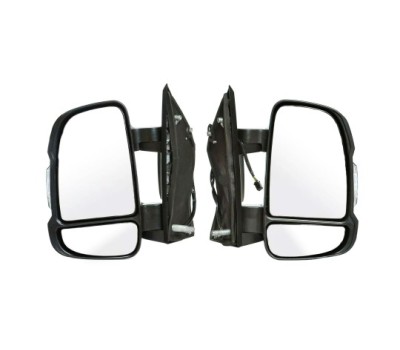
Some Ford Transit and VW Crafter mirrors include a temperature sensor wire in addition to the heater pair. That sensor wire matters and is colour coded separately. If your mirror has three or four wires running to the glass, not two, look up the connector pinout before you swap.
The four reasons a heated mirror fails
- The element is cracked. Look at the back of the glass when it is out of the housing. The printed element should be visible as fine lines on the plastic. A clean break across the lines means a dead zone in the middle of the mirror that never demists.
- The fuse blew. Same fuse as the heated rear screen on most cars. Check that one first.
- The connector behind the glass is corroded. Eight winters of road salt and condensation kill the spring tension in the spade clips. Disconnect, scrape both sides of each clip clean, reconnect.
- The relay has gone. Same relay that drives the rear demist. If the rear screen also takes longer than usual to clear, the relay is your culprit. Five pound part.
Testing without specialist tools
You do not need a multimeter to confirm whether your heated mirror is working. Spit on the glass on a cold morning. Press the rear demist button. Watch the dribble. If it evaporates within three minutes, the element is fine and your fault was elsewhere. If it sits there at four minutes, the glass element is gone or the supply has failed.
When to replace the glass versus the whole mirror
If only the heating fails but the glass itself is fine and the housing motors still work, replace the glass alone. About eighteen pounds for a heated stick on or clip on glass and a fifteen minute job. If the housing motor has packed up too (the mirror no longer adjusts electrically), the whole unit is usually the better buy because you would be opening the housing anyway.